The Body at the Table: Reading Emotional Tells Without Turning Card Night Into an Interrogation
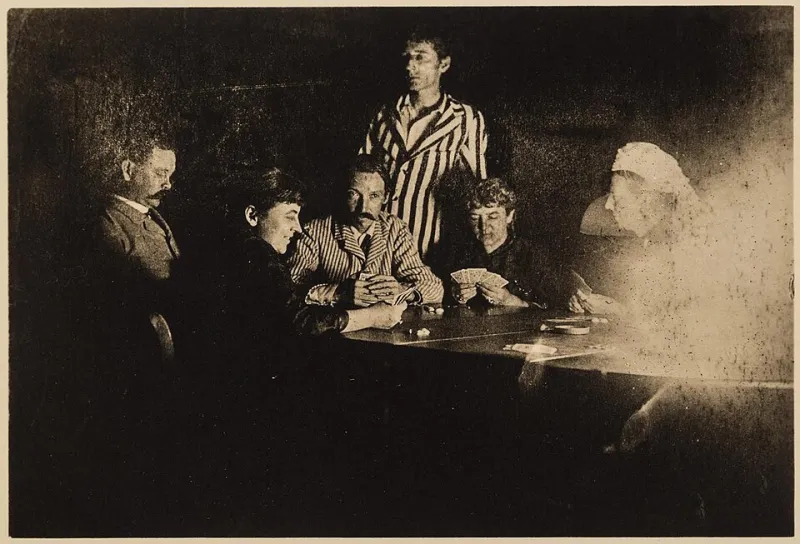
Photo: Unknown authorUnknown author, Public domain, via Wikimedia Commons
Ask a strong 27 Rummy player what they watch during a hand and you'll usually get the textbook answer: the discard pile, the draw count, the seats to their left. All correct. All incomplete.
Because there's a second stream of information running the whole time, and it's coming from the humans. Not in a spy-movie way — nobody's reading micro-expressions off a webcam. It's simpler than that. People are bad at hiding how a hand feels, and the way a hand feels is often a reliable preview of what it is.
Here's what to actually watch for, and how to do it without making your Tuesday night game feel like an interview room.
Pacing Is the Loudest Tell
Forget faces for a second. Listen to rhythm.
Every table settles into a natural tempo within the first few hands — how long people take to draw, how fast they discard, how much they chat between turns. That tempo is your baseline. The information lives in the deviations.
A player who normally snap-discards and suddenly takes two full beats is thinking about something. Sometimes that's a hard decision. Sometimes it's a decision they've already made and are trying to disguise. Either way, the pause is data.
The reverse is just as useful. A player who usually mulls things over and suddenly plays instantly is often trying to look casual about a card they're thrilled to be rid of — or one they're thrilled to have taken. Speed can be a costume.
The Confidence That Isn't
Newer players read overt confidence as strength. Experienced ones know better.
Real strength at a rummy table looks boring. It looks like a player whose timing hasn't changed, whose posture hasn't shifted, and who is still making the same dumb jokes they were making an hour ago. Comfort is quiet.
What you're looking for is performed comfort — the player who gets louder, faster, chattier, or suddenly starts explaining their own reasoning out loud. Over-explanation is a classic leak. When someone tells you unprompted why they made a particular discard, file that away. People defend decisions they're not sure about far more often than decisions they are.
Hands, Feet, and the Fidget Scale
Here's the one that actually works, and it's almost embarrassingly simple: establish where a player's hands normally are. Then notice when they move.
Some people tap. Some people hold their cards in a tight fan. Some lean back with one arm over the chair. Whatever the resting state is, that's the baseline. The signal is a change — a sudden re-fan of the cards, a hand moving to the chin, a foot starting to bounce under the table.
One caution: fidgeting is not a universal sign of a weak hand. Plenty of people fidget when they're excited. What you're measuring isn't 'nervous,' it's 'different than five minutes ago.' Different is the whole game.
The Between-Hands Channel
The richest information doesn't come during a hand at all. It comes in the two minutes after one ends, when the guard comes down.
Listen for how people talk about hands they lost. Players who recount a loss in precise detail — turn numbers, exact cards, what they were hoping for — are usually thinking players. Players who wave it off with 'the deck hates me tonight' are often playing looser than they realize. And the person who goes quiet after a big win, when they were chatty after a small one? That's a pattern worth tracking across a session.
You're not building a psychological profile. You're just noticing which version of a person shows up when they're winning and which shows up when they're not.
Where This Goes Wrong
Two big failure modes, and both are common.
First: over-reading. Human beings are pattern-detectors with a bad accuracy rate. One fidget does not mean anything. One pause does not mean anything. You need a repeat before you have a read, and you need several repeats before you have a read worth acting on. Collect signal, don't chase it.
Second: letting a read override the cards. If your read says 'they're weak' but the board says your hand is worse, the board wins. Tells are a tiebreaker, not a strategy. They nudge a close decision; they don't reverse an obvious one.
Keep It Fun
One last thing, and it matters more than any of the above: don't be weird about it.
Reading people is a skill, but narrating your reads out loud is a party trick that gets old by hand six. Nobody wants to play cards with the person who announces 'you hesitated, so I knew you didn't have it.' That's not sharp play; that's making the table smaller.
Use what you notice. Stay quiet about it. Let the play do the talking, and let the banter stay banter.
The best 27 Rummy players are, almost without exception, genuinely pleasant people to sit next to — right up until the cards are down. That's not a coincidence. It's the whole approach: warm at the table, cold on the decision.
Deal smart. Play sharp. Win big.